Stanislaviv Temperance Statue
Felix AustriaThe icon of the Virgin of Tenderness in Stanislaviv is a local devotional image whose recorded miracles draw Josef Ridny into a sustained investigation of the relation between faith and healing. For him, it is at once a sacred object and a case through which to test whether religious miracles and psychological suggestion might share a mechanism.
Setting and Devotional Record
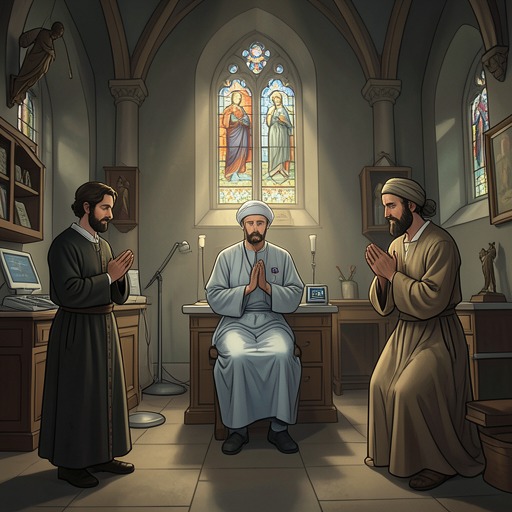
Josef visits the Armenian cathedral in Stanislaviv almost every day, walking its cold floor to study the icon and a detailed register of people who received grace or witnessed a miracle. The record preserves named incidents rather than presenting the image’s reputation as a general legend. On September 8, 1742, Marianna Yakoubovytch, who had suffered for years, prayed before the icon and was immediately relieved and restored to health. On November 5, the Jesuit priest Mykola Sacher reported that prayer before it had released him from a terrible headache. Later that month, Father Manouguevytch said he saw the icon amid azure clouds during a funeral service, a sight confirmed by Brother Dominique Donikevytch.
The register’s sequence brings together different kinds of testimony: recovery from illness and a vision within a service. Its names and dates give local devotion the form of an archive, while the stories it contains describe events that resist ordinary explanation. The icon’s authority in the city is thus conveyed both through the practices surrounding it and through accumulated accounts of what people say happened before it.
Josef’s Inquiry into Miracle and Suggestion
Josef’s interest in the icon grows from a wider preoccupation with the nervous system, the brain, and the possibility of explaining mysteries. He studies Mesmer in German and French despite Docteur Anger’s skepticism about Mesmer’s tubs, and follows the work of Jean-Martin Charcot and Ambroise-Auguste Liébeault. Josef agrees with Liébeault that hypnosis is psychological and that the capacity for suggestion belongs, to some degree, to all people.
That scientific framework does not make Josef dismiss religious experience. He is especially intrigued by Charcot’s perceived parallels between hypnosis and faith, whether religious or otherwise. From this perspective, the healings attributed to saints may operate through the same mechanism as hypnotic treatment. The icon matters to him precisely at this boundary: it is an object of devotion whose reported effects can also be approached as evidence in a search for the logic behind extraordinary experience.
Sacred Objects and the Theft Wave
The icon’s stories of healing stand amid reports of sacred objects disappearing from religious sites across the region. An ancient monstrance vanishes from the cathedral of Saint Anne in Ozeriany although the doors were locked, the windows undamaged, and the interior left in order. At Mykulyntsi, two gold patens disappear from a locked metal chest; elsewhere, reports include a silver etrog box from a synagogue’s secret hiding places, a kiddush cup, a hanukkiah, and an emerald-inlaid yad. These objects belong to distinct religious practices, but their reported losses accumulate into a shared climate of uncertainty.
When Josef and Petro discuss the disappearances, Petro proposes that the culprits might be the religious attendants themselves. Josef instead points to another possible connection: the objects have gone missing in cities where Ernest Thorn, a magician and swindler, has also been performing. Neither proposal is established as the explanation. Against this unresolved pattern, the icon represents sacred presence and reported grace, while the stolen objects raise questions about access, trust, and the limits of ordinary explanation.
The Icon’s Place in the Novel
The image joins two ways of interpreting the inexplicable without allowing either to settle the matter. The miracle register records healing and vision as acts of grace; Josef’s reading of hypnosis offers a psychological account of how faith and suggestion might produce effects understood as miraculous. His daily visits make this tension concrete: inquiry takes place not at a remove from devotional practice but on the cold floor of the cathedral, before the image and its testimony.
In a novel preoccupied with vanished sacred objects, the icon also marks a contrast between an image that remains present and inspires accounts of restoration, and objects whose sudden absence unsettles religious communities. Its importance lies in that conjunction of material devotion, recorded testimony, and competing explanations. The icon is neither reduced to a medical specimen nor detached from Josef’s inquiry: it is where the novel lets religious belief and the desire for rational understanding meet.